
Remember when keyword research meant typing a phrase into a tool, checking its search volume, and hoping you’d found something worth writing about?
For years, that was a familiar part of search engine optimization.
Find a keyword. Check the competition. Add it to your content. Repeat.
But the way people search — and the way we research their searches — is changing.
Artificial intelligence is transforming keyword research from a process of collecting phrases into a deeper exploration of what people actually want.
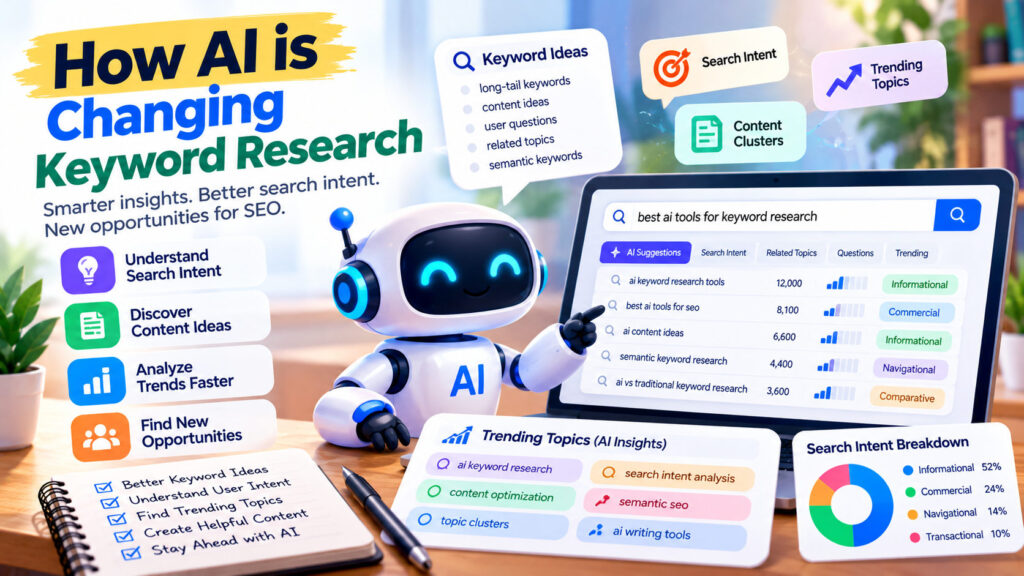
Instead of simply generating lists of keywords, AI can help us understand search intent, identify related questions, organize topics, discover content gaps, and develop better content strategies.
Does that mean traditional keyword research is becoming obsolete?
Not quite.
Let’s explore how AI is changing keyword research, what it can and cannot do, and how you can use it to improve your SEO without losing the human insight that makes content valuable.
1. Traditional Keyword Research vs. AI-Powered Keyword Research
Traditional keyword research typically begins with a seed keyword — a broad phrase related to your business or website.
You enter that phrase into a keyword research tool and examine information such as:
- Estimated monthly search volume
- Keyword difficulty
- Related keywords
- Cost-per-click estimates
- Competitor rankings
- Search trends
These metrics remain useful.
But they don’t always explain why someone searches for a particular phrase or what kind of answer would genuinely satisfy them.
AI can help bridge that gap.
What’s the difference?
| Traditional Keyword Research | AI-Assisted Keyword Research |
|---|---|
| Starts with individual keywords | Can start with topics, problems, or audience needs |
| Relies heavily on keyword metrics | Adds language and intent analysis |
| Often involves manual keyword grouping | Can suggest semantic topic clusters |
| Requires manually brainstorming variations | Can generate many relevant variations quickly |
| Primarily examines existing search data | Can propose new questions and content angles |
| Requires human interpretation | Still requires human interpretation and validation |
The important distinction is that AI doesn’t automatically provide accurate search-volume or competition data.
Unless an AI tool has access to a reliable keyword database, it may only be generating plausible suggestions.
AI can make keyword research more efficient, but reliable data still matters.
2. AI Helps Us Understand Search Intent
One of the most useful applications of AI in SEO is understanding search intent.
Search intent is the purpose behind a person’s search.
Consider these four searches:
- What is a profit margin?
- How to calculate profit margin
- Free profit margin calculator
- Best accounting software for small businesses
All relate to finance, but the people searching may have very different goals.
The four common types of search intent
Informational intent
The person wants to learn something.
Example: “How do I calculate percentage increase?”
Navigational intent
The person wants to find a particular website, company, or service.
Example: “Google Search Console login”
Commercial investigation
The person wants to compare options before making a decision.
Example: “Best free SEO tools for beginners”
Transactional intent
The person wants to complete an action, such as making a purchase or subscribing to a service.
Example: “Buy SEO software subscription”
AI can help classify groups of keywords according to these intentions.
This matters because the best content format depends on what visitors want.
Someone searching for an online calculator probably doesn’t want to read a 3,000-word article before performing a simple calculation.
They want a working calculator.
Try this AI prompt
“Analyze the following keywords and classify each according to informational, navigational, commercial, or transactional search intent. Suggest the most appropriate page format for each keyword and explain your reasoning.”
Paste your collected keywords after the prompt.
The result can help you decide whether to create a tutorial, comparison article, landing page, or interactive tool.
Remember to verify the classifications against actual search results.
3. AI Makes Long-Tail Keyword Discovery Easier
Long-tail keywords can be valuable because they often reflect specific needs.
For example:
Broad keyword: Percentage calculator
More specific queries:
- How to calculate percentage increase from two numbers
- Percentage calculator for exam marks
- How to calculate a discount percentage
- Percentage difference between old and new prices
Rather than manually brainstorming every possible variation, you can ask AI to explore a topic from different perspectives.
Example prompt
“Generate 30 specific search queries related to percentage calculations. Group them by students, shoppers, small business owners, and general users. Focus on real-world problems people might want to solve with an online calculator.”
This can quickly produce an organized collection of ideas.
But there’s an important limitation.
AI-generated keywords aren’t necessarily keywords people actually search for.
Before publishing content, validate promising suggestions using Google Trends, Google Search Console, or a keyword research platform.
An AI-generated phrase with no meaningful demand may not deserve a separate page.
For a deeper explanation, explore our guide on finding long-tail keywords for more traffic.
4. AI Helps Build Topic Clusters Instead of Isolated Articles
One of the biggest mistakes website owners make is treating every keyword as a separate content opportunity.
This can lead to dozens of articles covering almost identical questions.
AI can help identify how related topics fit together.
Suppose your website offers online financial calculators.
You might begin with the broad topic:
Profit and profitability calculations
AI could suggest a topic cluster such as:
| Main Topic | Related Content |
|---|---|
| Profit Margin Calculator | Calculate gross profit margin |
| Markup Calculator | Margin vs. markup explained |
| Discount Calculator | How discounts affect profit |
| Percentage Calculator | Calculate percentage profit |
| Business Profit Guide | Common profitability calculation mistakes |
Instead of publishing unrelated articles, you can organize content around a central topic.
Why does this matter?
A well-designed topic cluster can help:
- Visitors find related information
- Website owners identify missing content
- Search engines discover connected pages through internal links
- Reduce unnecessary duplication
- Make website navigation more useful
However, simply creating a topic cluster doesn’t guarantee better rankings.
Each page still needs a distinct purpose and useful content.
5. AI Can Accelerate Competitor Keyword Analysis
Competitor research has traditionally involved examining the keywords, pages, and backlinks associated with competing websites.
Tools such as Ahrefs and Semrush can provide data that helps with this process.
AI can make the analysis stage more efficient.
For example, you might export a competitor keyword report and ask an AI assistant to organize the findings.
Useful AI analysis tasks
- Group keywords by search intent
- Identify recurring subject areas
- Highlight content gaps
- Suggest suitable page formats
- Identify overlapping keyword groups
- Prioritize topics by relevance
Example prompt
“Analyze this competitor keyword report. Group the keywords into meaningful topics, identify content gaps relevant to a free online tools website, and suggest opportunities where an interactive tool could offer more value than a standard article. Use only the supplied metrics and do not invent search volumes.”
This final instruction is particularly important.
Without it, an AI assistant might present invented numerical estimates with unnecessary confidence.
AI is most valuable when it helps interpret trustworthy data rather than pretending to replace it.
6. AI Helps Discover Questions Behind Keywords
People don’t always search using short, carefully constructed keyword phrases.
They ask questions, describe problems, and search conversationally.
For example, instead of searching for:
“Working days calculator”
Someone might search:
“How many working days are there between two dates if I exclude weekends and public holidays?”
Both searches relate to a similar task, but the second reveals more about the person’s requirements.
AI can help identify these variations and convert them into useful content ideas.
A practical workflow
- Start with a broad topic.
- Ask AI to suggest likely user questions.
- Group questions by underlying problem.
- Check Google Search results for actual search intent.
- Validate demand where possible.
- Create content that answers the most useful questions.
For websites offering calculators and converters, this can reveal opportunities for tool improvements.
For instance, a date calculator might benefit from options to exclude holidays, customize weekends, or include the end date.
Sometimes the best SEO opportunity isn’t a new article.
It’s a better feature on an existing page.
7. AI Can Help Identify Emerging Keyword Opportunities
AI can assist in researching emerging topics, particularly when combined with current external data.
You might use Google Trends to identify rising searches, then use AI to organize related questions and potential content opportunities.
For example, if interest increases around a new productivity technology, AI might help generate:
- Beginner tutorials
- Comparison topics
- Frequently asked questions
- Practical use cases
- Related tool ideas
However, AI without current search data cannot reliably tell you which keywords are trending today.
Combine AI with real research tools
| Tool | Main Role |
|---|---|
| Google Trends | Identify changing search interest |
| Google Search Console | Understand your website’s search queries |
| Google Keyword Planner | Explore keyword and advertising search-demand estimates |
| Ahrefs or Semrush | Investigate keywords and competitors |
| AI assistants | Organize findings and generate useful research ideas |
Think of AI as an assistant that helps you interpret the evidence.
Don’t treat it as the evidence itself.
8. AI Is Changing How People Search
AI isn’t just changing keyword research tools.
It’s also changing the search experience.
Traditional search engines have long displayed pages of results for people to explore.
AI-powered search experiences can also provide synthesized answers, suggest follow-up questions, and help users explore topics conversationally.
Google’s AI Overviews and AI Mode are examples of AI features integrated into search.
This raises an important question:
If an AI system can answer someone’s question directly, why would they visit your website?
The answer depends partly on what your website offers.
A simple factual answer may be satisfied without a click.
But users may still need to:
- Perform calculations
- Upload or convert files
- Compare interactive results
- Explore detailed examples
- Verify information
- Use specialized tools
- Complete tasks that an AI-generated summary cannot perform directly
This creates an important opportunity for utility websites.
A functional tool can provide a different kind of value from a paragraph explaining how that tool works.
Do websites need special optimization for AI search?
Google’s guidance emphasizes that established SEO fundamentals still apply to its AI search features.
There is no special schema markup or additional technical requirement solely for appearing in Google AI Overviews or AI Mode.
Useful, original content, crawlability, clear page structure, and a good user experience remain important.
That means website owners should avoid chasing questionable shortcuts promising guaranteed AI search visibility.
9. AI Makes Content Planning Faster
Keyword research isn’t useful until you turn it into a content strategy.
AI can help transform research findings into an editorial plan.
Suppose you have 50 keyword ideas.
Instead of manually reviewing each one, you could ask AI to organize the list.
Example prompt
“Using the keyword list below, create a content plan for a website offering free online utilities. Group related keywords, identify search intent, recommend the most suitable content format, and prioritize opportunities based on the supplied data. Avoid creating separate pages for keywords that share the same search intent.”
The output could include:
- Keyword clusters
- Article topics
- Tool-page improvements
- FAQ opportunities
- Suggested internal links
- Proposed publishing priorities
Sample content plan
| Topic | Recommended Content |
|---|---|
| Percentage calculations | Guide supported by an interactive calculator |
| Profit margin vs. markup | Comparison article |
| Working days calculations | Calculator with customization options |
| JSON formatting | Developer tutorial and formatter |
| Image aspect ratios | Visual guide and aspect ratio calculator |
This approach can reduce repetitive planning work and help maintain a clearer content structure.
10. The Biggest Risks of Using AI for Keyword Research
AI offers useful capabilities, but relying on it blindly can lead to poor SEO decisions.
Mistake 1: Trusting invented search volumes
An AI assistant might generate plausible numbers even when it has no access to real keyword databases.
Never treat unsupported figures as reliable keyword research.
Mistake 2: Publishing everything AI suggests
AI can generate hundreds of article ideas in seconds.
That doesn’t mean you should publish all of them.
Focus on topics relevant to your audience and website.
Mistake 3: Creating multiple pages for identical intent
Several similar keywords may be better served by one comprehensive page.
Publishing near-duplicate pages can confuse visitors and create unnecessary content maintenance.
Mistake 4: Ignoring the actual search results
AI may misunderstand what searchers expect.
Check the search engine results to see whether users appear to want tools, tutorials, products, or comparisons.
Mistake 5: Publishing generic AI-generated articles
Mass-producing repetitive content without adding meaningful value is a weak long-term strategy.
Google’s guidance emphasizes helpful, reliable, people-first content.
AI can assist with research and writing, but you should contribute original explanations, practical examples, accurate information, and genuine expertise.
Mistake 6: Sharing confidential information
Don’t upload private customer information, proprietary analytics, or confidential business reports to AI services without appropriate authorization and privacy safeguards.
11. A Practical AI-Powered Keyword Research Workflow
Here’s a simple process you can follow without buying several expensive SEO subscriptions.
Step 1: Choose a topic
Start with something relevant to your website.
Example: Online percentage calculations.
Step 2: Generate ideas with AI
Ask an AI assistant to suggest related questions, user problems, and content angles.
Step 3: Validate search interest
Use Google Trends, Search Console, or a dedicated keyword research platform.
Step 4: Examine the competition
Search for your target queries and inspect the existing results.
Look for opportunities to offer something more useful.
Step 5: Group keywords by intent
Use AI to organize related queries into meaningful clusters.
Step 6: Choose the right format
Decide whether a tutorial, comparison article, interactive calculator, or updated tool page would best satisfy the user.
Step 7: Create original content
Use AI for assistance, but include clear explanations, tested examples, and accurate information.
Step 8: Build internal links
Connect new content to existing relevant tools and articles.
Step 9: Measure performance
Monitor impressions, clicks, queries, and landing pages in Google Search Console.
Step 10: Improve based on evidence
Review what visitors are searching for and adjust your content when there’s a useful reason to do so.
The process can be summarized simply:
Discover → Validate → Understand → Create → Measure → Improve
That’s where AI can be genuinely valuable: making the research and planning stages faster while keeping decisions grounded in real data.
12. Will AI Replace Traditional Keyword Research Tools?
Probably not entirely.
AI is changing how keyword research is performed, but traditional SEO data remains important.
An AI assistant can generate excellent keyword ideas.
However, generating an idea isn’t the same as measuring search demand.
Similarly, AI can recommend a promising topic, but that recommendation should be evaluated against competition, search intent, and audience relevance.
The future of keyword research is likely to involve combining different capabilities.
| AI Is Particularly Useful For | Traditional SEO Data Is Useful For |
|---|---|
| Brainstorming keyword ideas | Estimating search volume |
| Understanding possible search intent | Measuring actual search impressions |
| Clustering related queries | Monitoring ranking changes |
| Planning content structures | Analyzing competitor visibility |
| Identifying potential content gaps | Validating trends and performance |
| Generating research questions | Measuring results over time |
The strongest approach is to use both.
Final Thoughts: AI Makes Keyword Research Smarter, Not Automatic
Artificial intelligence is changing SEO research in meaningful ways.
It can help us move beyond isolated keywords and understand the questions, problems, and intentions behind searches.
It can organize complex keyword lists, uncover possible content gaps, suggest relevant topics, and reduce hours of repetitive research.
But AI doesn’t eliminate the need for judgment.
Search-volume estimates still need verification. Search intent still needs investigation. Content still needs accuracy and originality.
And ultimately, a successful SEO strategy isn’t about generating the largest possible list of keywords.
It’s about understanding what people need and creating something genuinely useful for them.
For bloggers, marketers, small businesses, and website owners, that’s an exciting opportunity.
Use AI to work smarter, validate your ideas with reliable data, and focus on delivering real value.
And when you need useful online utilities, explore WebToola for free calculators, converters, developer tools, and everyday digital resources.
Frequently Asked Questions
Can AI perform keyword research?
Yes. AI can generate keyword ideas, organize related queries, analyze potential search intent, and assist with content planning. Accurate search-volume and competition analysis generally requires access to external keyword or search-performance data.
Is ChatGPT a replacement for Google Keyword Planner?
No. ChatGPT can assist with brainstorming and analysis, but Google Keyword Planner provides advertising-oriented keyword estimates based on Google’s data. They serve different purposes and can complement each other.
Can AI find low-competition keywords?
AI can suggest potentially less competitive topics, but it cannot reliably establish keyword difficulty without appropriate data and search-results analysis.
How can AI help with long-tail keywords?
AI can generate specific question variations, audience-based queries, and related problems. These suggestions should be validated before being selected as SEO targets.
Does Google penalize AI-generated content?
Google’s guidance focuses on content quality and purpose rather than simply whether AI was involved. Using automation to produce large amounts of low-value content for manipulating rankings can violate its spam policies.
How is AI changing search intent?
AI can help researchers analyze conversational queries, identify related user needs, and group searches by purpose. AI-powered search experiences also allow users to explore topics through more interactive questions and answers.
Should small websites use AI for SEO?
AI can be especially useful for small websites with limited research resources. Start with keyword brainstorming, topic clustering, and content planning, while validating important decisions using reliable SEO data.
Will keyword research still matter in the future?
Yes. Understanding how people describe their needs remains valuable, even as search interfaces evolve. Keyword research may become more closely connected with audience research, topic analysis, and user-intent understanding.