
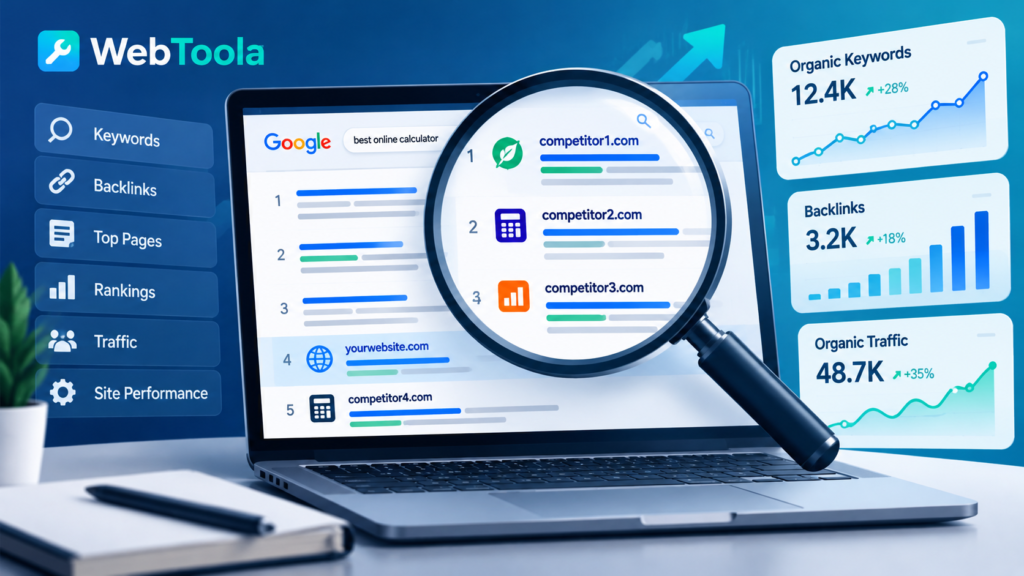
Ever wondered why your competitor’s website keeps showing up on Google while yours struggles to get noticed?
Perhaps they’re targeting keywords you’ve never considered. Maybe they’re getting backlinks from websites you didn’t even know existed. Or perhaps their content answers questions your website hasn’t addressed yet.
Here’s the good news: you don’t need to be a detective, a hacker, or an SEO expert to uncover these opportunities.
With the right SEO tools and a little curiosity, you can learn a surprising amount about your competitors’ online strategies — completely legally.
Let’s explore how to do it.
1. First, Find Out Who Your Real SEO Competitors Are
Your business competitors and your SEO competitors aren’t necessarily the same people.
For example, if you operate a website offering free online calculators, your SEO competitors might include educational websites, financial blogs, or large utility platforms — not just other calculator websites.
Try this:
- Open Google in a private browsing window.
- Search for a keyword you want your website to rank for.
- Examine the first 10 organic results.
- Identify websites that repeatedly appear for related searches.
- Make a shortlist of three to five competitors.
Useful tools:
- Google Search
- Ahrefs Site Explorer
- Semrush Organic Research
- Similarweb
Pro tip: Focus on websites competing for the same search queries rather than simply copying the biggest names in your industry.
2. Discover the Keywords Bringing Them Traffic
Keywords are one of the most valuable clues in competitive SEO research.
Imagine discovering that a competitor receives substantial search traffic from a phrase you’ve completely overlooked.
That’s an opportunity worth investigating.
Tools such as Ahrefs and Semrush can estimate which keywords competing websites rank for, their positions in search results, and their potential organic traffic.
What should you look for?
- High-volume keywords: Popular searches relevant to your audience.
- Long-tail keywords: More specific phrases that may be easier to target.
- Keyword gaps: Terms competitors rank for but your website doesn’t.
- Low-competition opportunities: Relevant searches where weaker pages currently rank.
For example, instead of competing immediately for “percentage calculator,” you might explore more specific searches such as:
- How to calculate percentage increase
- Percentage difference between two numbers
- How to calculate a discount percentage
- Profit margin vs. markup calculator
These are examples to investigate, not verified keyword opportunities. Always check their actual demand and competitiveness.
The trick isn’t to steal keywords. It’s to discover what your audience is searching for and serve them better.
3. Examine Their Most Successful Content
Your competitor’s best-performing pages can reveal what readers genuinely want.
Use an SEO research tool to identify pages estimated to attract the most organic traffic.
Then visit those pages and ask yourself:
- What question does this page answer?
- Is the information easy to understand?
- Does it contain useful examples?
- Are there interactive tools or calculators?
- Is the content current and accurate?
- What’s missing that I could explain better?
The Content Gap Opportunity
Suppose a competitor publishes a detailed article explaining how to calculate profit margins.
The article is informative, but visitors must perform the calculations manually.
You could create a better experience by combining:
A clear explanation + practical examples + an interactive profit margin calculator.
That’s how competitive research becomes useful innovation rather than imitation.
4. Investigate Where Their Backlinks Come From
Backlinks are links from other websites pointing to a particular website.
Search engines may use these links as signals when evaluating pages, although link quality, relevance, and context matter far more than simply collecting large numbers of links.
Tools such as Ahrefs, Semrush, and Moz can help investigate competitors’ backlink profiles.
Look for opportunities such as:
- Blogs referencing competing tools
- Educational websites linking to useful resources
- Industry directories with genuine editorial standards
- Articles featuring relevant calculators or utilities
- Websites publishing resource lists
For instance, if an educational blog links to a competitor’s percentage calculator, you could consider reaching out with your own useful resource.
However, don’t automatically request a link simply because a competitor has one.
Give publishers a genuine reason to recommend your page.
Avoid buying spammy links, participating in link schemes, or sending mass outreach messages. Those tactics can harm your reputation and search visibility.
5. Check Their Website Speed and Technical SEO
Sometimes competitors outperform your website not because they have better articles, but because they offer a better user experience.
Technical SEO can influence how efficiently search engines discover, crawl, and understand pages.
Start by examining competing websites with publicly accessible testing tools.
Tools worth trying
Google PageSpeed Insights
Analyze loading performance, accessibility-related diagnostics, and technical improvement opportunities.
Google Lighthouse
Evaluate performance, accessibility, SEO basics, and other page-quality characteristics.
Chrome DevTools
Inspect network requests, page resources, layout behavior, and potential performance bottlenecks.
Pay attention to:
- Mobile usability
- Loading performance
- Core Web Vitals
- Page structure
- Image optimization
- Internal navigation
Remember that public performance tests don’t reveal everything about a competitor’s technical SEO. Results can also vary by device, location, and testing conditions.
The goal is to identify ideas you can apply to your own website.
6. Study Their Titles and Meta Descriptions
Here’s a simple SEO research technique that doesn’t require a paid subscription.
Search for your target keyword and examine how competing pages present themselves in Google’s results.
Consider these two titles:
Example A: Percentage Calculator
Example B: Free Percentage Calculator – Calculate Percentages Instantly
Which one communicates more value to someone looking for a quick calculation?
The second title provides additional context and a clearer benefit.
When analyzing competitors, look for:
- Clear, descriptive titles
- Natural keyword placement
- Specific benefits
- Search-intent alignment
- Helpful meta descriptions
Don’t copy their titles word for word. Use what you learn to create something more useful and relevant.
Also remember that Google may generate its own title links and snippets rather than displaying your supplied text exactly.
7. Explore Their Internal Linking Strategy
Internal links help visitors navigate a website and help search engines discover related pages.
A well-organized competitor might connect a discount calculator to articles about shopping discounts, percentages, and sales tax.
This creates a useful network of related resources.
When reviewing competing websites, investigate:
- How pages are grouped into categories
- Which related tools are recommended
- Whether explanatory articles link to relevant utilities
- How easily visitors can find related information
- Whether important pages are accessible through normal navigation
For a utility website, internal linking can be particularly valuable.
For example, someone using a percentage calculator might also benefit from a percentage change calculator or a discount calculator.
A useful internal link helps the visitor continue their task without having to search elsewhere.
8. Monitor Your Competitors Without Obsessing Over Them
Competitive SEO research shouldn’t be a one-time exercise.
Search results evolve, competitors publish new content, and audience interests change.
Set aside some time each month to review your most important competitors.
You can track:
- New pages and tools they’ve published
- Changes in important keyword rankings
- Newly discovered backlinks
- Changes to titles and page structure
- Emerging topics in your niche
Google Alerts can help you discover new public mentions of brands or topics. Specialized SEO tools can provide more detailed competitive monitoring.
Just remember that third-party traffic and keyword estimates are not the same as access to a competitor’s actual Google Analytics or Search Console data.
Treat estimates as clues, not guaranteed facts.
9. Turn Your Findings Into an Action Plan
Collecting competitor data is easy. Turning it into meaningful improvements is what matters.
Here’s a simple example:
| What You Discover | What You Can Do |
|---|---|
| Competitor ranks for a useful keyword | Create a relevant, genuinely helpful page |
| Competitor’s article lacks examples | Add practical examples and explanations |
| Competitor offers a difficult-to-use tool | Build a simpler, more accessible experience |
| Competitor receives relevant editorial backlinks | Develop a resource worth recommending |
| Competitor has excellent internal navigation | Improve your own related-content structure |
| Competitor’s page loads slowly | Make performance a priority on your website |
Start with improvements that offer real value to your audience and are achievable with your available resources.
You don’t have to outperform every competitor at everything.
Sometimes, doing one important thing exceptionally well is enough to make your website worth visiting.
10. Free vs. Paid SEO Tools: Which Should You Use?
You don’t need an expensive SEO subscription to begin competitive research.
Here’s a quick comparison:
| Tool | Useful For | Free Access |
|---|---|---|
| Google Search | Discovering competitors and search results | Yes |
| Google Trends | Comparing search interest in topics | Yes |
| Google PageSpeed Insights | Analyzing public-page performance | Yes |
| Google Lighthouse | Auditing page performance and SEO basics | Yes |
| Ahrefs | Keywords, backlinks, and competitor research | Limited features; paid plans |
| Semrush | Competitive keywords, rankings, and backlinks | Limited features; paid plans |
| Similarweb | Traffic estimates and competitive insights | Limited features; paid plans |
| Moz | Link research and SEO analysis | Limited features; paid plans |
Free access and usage limits can change, so check each provider’s current offering.
For beginners, start with Google Search, Google Trends, and PageSpeed Insights. Consider paid tools when you need broader keyword databases, backlink research, or regular competitive reports.
Is Spying on Competitors Legal?
The word “spying” sounds dramatic, but the methods discussed here are generally forms of legitimate competitive research.
Analyzing publicly available search results, web pages, backlinks, and performance data is different from accessing private systems.
Stay on the right side of the line:
- Research publicly available information.
- Respect website terms and applicable laws.
- Don’t attempt to access private analytics or accounts.
- Don’t bypass security controls.
- Don’t copy competitors’ copyrighted content.
- Don’t impersonate others to obtain confidential information.
The purpose of competitive SEO analysis is to learn from the market, not interfere with competitors.
Final Thoughts: Learn From Competitors, But Build Something Better
Your competitors have already invested time experimenting with keywords, content, website design, and SEO strategies.
Their public websites can provide valuable clues about what works — and what doesn’t.
But here’s the most important lesson:
The goal isn’t to become a copy of your competitor. The goal is to understand your audience better than your competitor does.
Use SEO tools to discover opportunities, identify weaknesses, and improve the experience you provide.
Whether you’re running a blog, an online business, or a website full of useful tools, thoughtful competitor research can help you make smarter decisions.
And while you’re improving your website, explore the free calculators, converters, and online utilities available at WebToola.com.
Because sometimes the best way to compete is simply to make things easier for your visitors.
Frequently Asked Questions
Can I analyze competitors’ SEO without paying?
Yes. Google Search, Google Trends, PageSpeed Insights, and free or limited-access SEO research tools provide a useful starting point. Paid tools generally offer more comprehensive keyword, backlink, and ranking datasets.
Can I see exactly how much traffic a competitor receives?
Usually not. Third-party SEO platforms estimate traffic using their own datasets and models. Exact analytics generally remain private unless the website owner shares them.
Is it okay to use the same keywords as my competitors?
Yes. Keywords aren’t owned by individual websites. However, you should create original content that satisfies the searcher’s needs rather than copying competing pages.
How often should I analyze my competitors?
A monthly review is a reasonable starting point for many smaller websites. More competitive industries may benefit from weekly monitoring.
What’s the most important thing to learn from competitor SEO research?
Look for unmet user needs. Discover what people are searching for, where existing results fall short, and how you can provide a more helpful experience.